
REVIEW · WALKING TOURS
Half Day – Nairobi City Walking/Bus Tour Museums, Monuments & Rooftop City View
Nairobi feels like a city of stories you can walk right into. This half-to-full-day small-group tour mixes matatu rides with real downtown stops, from the National Archives to the Nairobi Railway Museum, then finishes with big skyline views from the KICC rooftop.
I really liked two things right away. First, the tour stays in the working rhythm of the city with rides that feel like local radio, not a scripted bus loop. Second, the museum pair is a smart combo, art and photos at the Archives, then the rail story at the Railway Museum, so you get culture plus infrastructure in one go.
One thing to plan for: museum tickets and the KICC rooftop fee are not included in the $61 price. Budget the extras up front so the day stays smooth.
In This Review
- Key things you will enjoy most
- Price and value for your $61
- The core idea: central Nairobi without the usual shortcuts
- Stop 1: Nairobi National Archives on Moi Avenue
- Stop 2: Kasarani by matatu, a lesson in how Nairobi runs
- Stop 3: Nairobi Railway Museum and Kenya’s growth story
- Stop 4: KICC rooftop for 360-degree city views
- Walking, matatus, and your comfort level
- What the small group size changes
- Who this tour is best for
- A realistic schedule: how the time adds up
- Should you book this Nairobi walking and matatu museum tour?
- FAQ
- How long is the Nairobi City Walking/Bus Tour?
- What time does the tour start?
- Where is the meeting point?
- What is the group size limit?
- What is included in the $61 price?
- Are the museum and rooftop entry fees included?
- How much are the admission fees?
- What transport do you use during the tour?
- Is this tour suitable for everyone physically?
- Can I cancel for a full refund?
Key things you will enjoy most
- A group capped at 7 keeps the pace human and the questions coming
- Matatu transport gives you a street-level feel for how Nairobi moves
- National Archives stop includes tribal photography, weaponry, instruments, and independence-era exhibits
- Railway Museum focus connects Kenya’s growth to the rail system
- KICC rooftop views bring a 360-degree look at the central business district and major government buildings
- Hotel-free, simple rhythm starts at Moi Avenue and returns to the same meeting point
Price and value for your $61
At $61 per person, this is priced as a guided day with transport and interpretation, not as a ticket bundle. What you are paying for is the guiding fee plus the tour’s structure: museums, monuments, and a rooftop viewpoint, with matatu or shared minibuses used to connect areas of the city.
Then you add the admissions you will pay separately. The National Archives entry is listed at $3, the Nairobi Railway Museum is $3, and the KICC rooftop is $5. In total, that is about $11 more for entry fees, putting a realistic day total around $72 per person (depending on how the provider collects payments).
For the cost, I think the value is strongest if you like context. If you just want to tick off a few landmarks, you might feel the admissions add up. But if you want explanations that connect Nairobi’s independence story, cultural collections, and rail history to what you see in town, the guide time is what you are buying.
More City Tours in Nairobi
- Nairobi Historical Walking City Tour
★ 5.0 · 258 reviews - Nairobi City Walking Tour with Traditional Kenyan Lunch
★ 5.0 · 106 reviews - Nairobi Cultural and Historical City Tour with a Local
★ 5.0 · 67 reviews
The core idea: central Nairobi without the usual shortcuts

This tour is built around downtown Nairobi, with a mix of walking and local transport. That matters because Nairobi’s center is not just a set of pretty views. It is neighborhoods, institutions, and daily movement, all packed close enough that you can actually cover a lot without feeling rushed.
The walking portion is also the reason the day works. You get to register how streets and buildings relate to each other, then you bounce by matatu or shared minibuses for the stretches that make more sense by road. The day is not a museum-only crawl, and it is not a sightseeing-only bus ride either.
One nice detail for practical travelers: your day ends back at the meeting point. So you do not have to figure out how to get across town at the end after dark-or-after fatigue kicks in.
Stop 1: Nairobi National Archives on Moi Avenue
The tour kicks off at 8:30 AM at the National Archives on Moi Avenue (30 Moi Ave). From there, you spend about one hour at the National Archives, which is described as a little-visited museum and art gallery.
What I’d expect you to find here is more varied than a typical archive visit. The collection includes paintings and tribal photographs from throughout Africa, plus an enormous set of tribal weaponry, instruments, masks, and other cultural objects. On top of that, you get exhibits that focus on the struggle for independence and the history of Nairobi.
Why this stop is valuable: it gives you a foundation before you go looking at rail lines, government buildings, and skyline views. Even if you already know a few broad facts about Kenya’s past, seeing the materials grouped into cultural and independence themes makes the city feel less random.
A small consideration: because this is an Archives visit, you may spend time reading labels and taking in visual collections. If you are short on patience for museums, plan to approach it like an orientation stop, not a quick browse.
Stop 2: Kasarani by matatu, a lesson in how Nairobi runs
After the archives, you take a two-way ride in Kenya’s famous matatus. The itinerary places this as the Kasarani segment, and it is about two hours total.
The key detail here is not just transportation. Matatus are described as moving canvases, with designs featuring hip-hop artists, international pop stars, athletes, political icons, and even religion. The result is a vehicle that feels like a rolling announcement board for pop culture and politics at the same time.
Why you will probably like it: it breaks the “stand still and look” pattern of many city tours. Instead of only seeing Nairobi from outside, you experience the energy of shared transport, the stop-and-go rhythm, and the way you notice people and signage while you are in motion.
What to consider: two hours on local transport can be tiring if you are heat-sensitive or if crowds feel stressful. If you are prone to motion discomfort, take it slow and try to keep your attention on breathing and hydration.
More Walking Tours in Nairobi
- Nairobi: Historic and Modern Highlights Walking Tour
★ 4.8 · 703 reviews - Nairobi Downtown Walking Tour
★ 4.7 · 208 reviews - Nairobi Walking Tour: Downtown & City Tour
★ 4.8 · 32 reviews - Day tour to Hells Gate, Lake Naivasha and Crescent Island Walk
★ 5.0 · 26 reviews
Stop 3: Nairobi Railway Museum and Kenya’s growth story
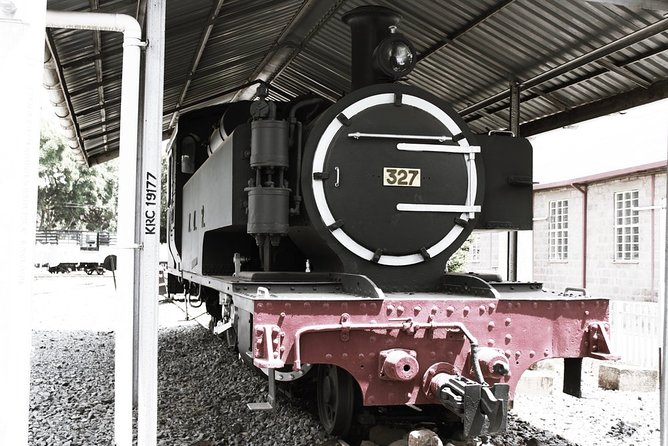
Next is the Nairobi Railway Museum, with about 45 minutes planned. This is closely tied to Kenya Railways, and the museum framing is about the historical growth of the country, with the rail system as a key driver of development.
Even with a shorter time window, the payoff here is how the story connects to the bigger picture. Rail is not just trains. It shapes where people live, where goods move, how jobs spread, and how cities expand. By focusing on that, the museum helps you understand why Nairobi became what it is.
A practical note: because the time is set at around three quarters of an hour, you will want to pick what you pay attention to. If you like technology, look for the artifacts that show how rail systems worked. If you are more into social history, spend time with the exhibits that explain how the rail pushed Kenya’s evolution.
Stop 4: KICC rooftop for 360-degree city views
The day ends at the Kenyatta International Conference Center rooftop, for about 30 minutes. KICC also doubles as a helipad, and that fact alone hints at how important the building is in the city’s center.
From the rooftop, you get a 360-degree view of the central business district. You also get to see monumental buildings like the office of the president and Kenya’s parliament, along with other major structures nearby.
Why rooftop views are worth doing here: they are not just “pretty photos.” You are looking at governance and power clustered in one area, then you connect it back to what you learned earlier. The archives help explain the independence struggle, the rail museum adds the growth mechanism, and then the skyline puts it all into a single visual context.
A consideration for planning: rooftops can feel hotter or breezier depending on the day. Bring a hat or something for sun cover if you are sensitive, and take breaks between angles so you do not rush your photos.
Walking, matatus, and your comfort level
This tour is listed as requiring a moderate physical fitness level. That usually means you should be ready for walking around city areas, plus time standing in museum spaces. You do not need to be an athlete, but you should plan for at least a decent amount of walking during the day.
The route also uses public-facing transportation. The listing says you are near public transportation, which is reassuring if you need a backup plan. Still, the tour itself relies on matatus or shared minibuses for parts of the journey, so expect real street conditions, not a quiet private vehicle.
My practical advice: wear comfortable shoes with good grip, keep water with you when possible, and go into it expecting the day to feel like a local schedule rather than a museum timetable.
What the small group size changes
The experience is capped at a maximum of 7 travelers. In my opinion, this is the main quality upgrade you get for this price.
With smaller numbers, you spend less time herding people. You can ask more questions without waiting for the group to catch up. And when you are dealing with museums that have lots of written context, a guide who can answer you quickly is a big advantage.
The review feedback also lines up with that. One standout comment called out an excellent walk around central Nairobi away from the normal routine sights, and praised a pleasant young man with good knowledge of the area. That kind of guide effort matters most when you want more than a list of stops.
Who this tour is best for
This tour fits best if you want a Nairobi introduction that feels grounded in institutions and everyday movement.
Choose it if you:
- Want culture plus civic history, not just photos
- Like local transport and want to experience matatus as part of the day
- Enjoy walking segments where you can actually read the city
- Prefer a small-group format instead of a large bus with strangers
If you mainly want iconic landmarks with minimal time in museums, you might find some parts too “learny.” But if you like context, the museum pair plus the rooftop makes a tidy storyline.
A realistic schedule: how the time adds up
The itinerary is set to roughly 5 to 7 hours, starting at 8:30 AM. The planned blocks are: 1 hour at the National Archives, about 2 hours for the matatu ride segment, 45 minutes at the Railway Museum, and 30 minutes at the KICC rooftop.
That structure is good for travelers who like a morning start. You get the most museum time earlier, then finish with views. The day also avoids being so packed that you need to sprint between stops.
Keep an eye on how long you linger. If you love label reading, you might run a bit over on the museum segments. If you want the day to feel smooth, you might need to be a bit selective about which exhibits to focus on.
Should you book this Nairobi walking and matatu museum tour?
I would book it if you want a Nairobi day that feels both practical and story-driven. The mix of National Archives cultural collections, the rail-focused museum, and then rooftop city overview gives you a clearer picture than a single-topic tour.
Book if you value:
- Small group attention and a guide who can explain what you are seeing
- Matatu rides as a core part of the experience, not just a transfer
- A downtown route that helps you get oriented fast
Skip it if you dislike museums, do not want local transport, or you have zero interest in independence-era and infrastructure context. In that case, you might prefer a simpler sightseeing option with only paid attractions you already care about.
If you do book, show up ready for a moderate day: comfortable shoes, water, and a plan to pay the listed entry fees so you are not scrambling during the stops.
FAQ
How long is the Nairobi City Walking/Bus Tour?
It runs for about 5 to 7 hours.
What time does the tour start?
The start time is 8:30 AM.
Where is the meeting point?
You meet at Nairobi National Achieves on Moi Avenue, 30 Moi Ave, Nairobi, Kenya.
What is the group size limit?
The tour has a maximum of 7 travelers.
What is included in the $61 price?
The guiding fee is included. You also get a mobile ticket.
Are the museum and rooftop entry fees included?
No. Entry/Admission for the National Archives, Nairobi Railway Museum, and the KICC rooftop are purchased separately.
How much are the admission fees?
National Archives is $3, Nairobi Railway Museum is $3, and the Kenyatta International Conference Center rooftop is $5.
What transport do you use during the tour?
You walk and you also ride local matatus or shared minibuses, including a two-way ride as part of the Kasarani segment.
Is this tour suitable for everyone physically?
It’s listed for travelers with a moderate physical fitness level.
Can I cancel for a full refund?
Yes, you can cancel up to 24 hours in advance for a full refund. If you cancel less than 24 hours before the start time, you will not be refunded.
More Museums in Nairobi
- Day tour to Giraffe Center and Karen Blixen Museum
★ 4.5 · 168 reviews - Nairobi National Park,Giraffe Centre, Karen Blixen Museum.
★ 5.0 · 127 reviews - Giraffe Center and Karen Blixen Museum Tour from Nairobi
★ 4.6 · 43 reviews - Nairobi National Park, Giraffe Center & Karen Blixen Museum
★ 4.5 · 42 reviews
Newest write-ups from Nairobi
- Visit kibera Slum the chocolate city★ 4.8 · 3 reviews
- 3 days maasai mara migration safari★ 4.5 · 7 reviews
- 4 Days Tour Landcruiser in Masai Mara and Lake Nakuru★ 5.0 · 10 reviews
- 4 Days Safari to Lake Nakuru N/P and Maasai Mara N/R★ 5.0 · 18 reviews
- Day Tour to Nairobi national park, Elephants, and Giraffe Center★ 3.5 · 8 reviews
- Wildebeest Migration in Masai Mara and Sightseeing 4 Days Tour★ 4.5 · 6 reviews
- Maasai Mara Day Trip★ 5.0 · 15 reviews
- Kibera Slum Tour with a Local★ 5.0 · 15 reviews
Walking Tours, compared.


Walking Tour Through Old Town Mombasa and Fort Jesus
Read our review →

Nairobi Walking tour:Explore History Culture and Traditions
Read our review →

Nairobi City Walking Tour with Traditional Kenyan Lunch
Read our review →

Browse the lists this tour appears in